




 Corey Lane FIOC who specialises in the survey, repair, and adaptation of heritage assets shares with us the need for further research to protect timber framed buildings from current and future weather systems.
An old Spanish proverb suggests that if one wishes to trouble an enemy, one might gift them an old house. In Britain however, those familiar with the pathology of historic buildings may reasonably refine that advice to read: if real mischief is intended, make sure it is a timber framed building.
For, whilst timber framed buildings occupy a special place in the within Britain’s architectural lexicon, for the most part they are considered complicated, troublesome and thermally inefficient. These views are not incidental; they arise out of a century and a half of misunderstanding and the removal of the weathering systems that once protected them.
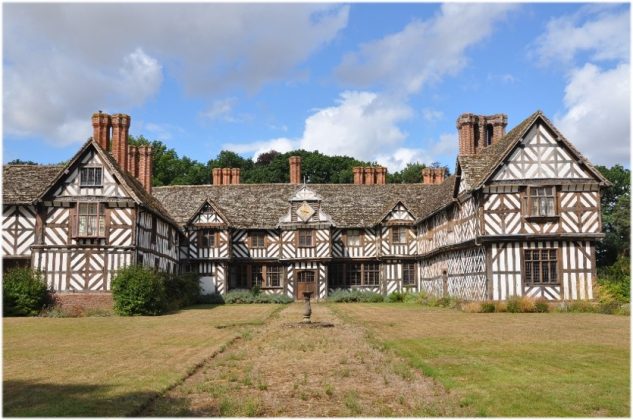
Pitchford Hall, Shropshire. Constructed c.1560 by John Sandford & Son’s, Master Carpenter and Warden of the Worshipful Company of Carpenters.
Structure of Timber Framed Buildings
Unlike masonry buildings, where the structure and principal weathering surface are one and the same, Britain’s timber framed buildings were formed in two distinct construction stages. The primary frame was erected first, creating a structural load bearing skeleton. The building envelope was then infilled and fenestrated, prior to the application of external surface finishes or weather screening – the selection of which was dependent upon status, the function of the structure, prevailing climatic conditions and vernacular tradition.
This distinction of the timber frame in this context is critical because its primary function is to provide structural support. In practice, deficiencies in the weathering performance of timber framed buildings are rooted in the slenderness of the wall profile and the numerous construction joints and interfaces. In addition to which, even when the heartwood of framing members are correctly orientated externally, the numerous cracks, naturally occurring defects and construction voids create pathways that can be readily exploited by air movement and moisture penetration.
Where moisture ingress continues unabated, natural erosion process and the loss of fibres will naturally spike, whilst surface environments are created that increase the risk of biological decay and insect attack.
Yet despite these vulnerabilities, and exposure to Britain’s variable climate, approximately 68,000 examples of timber framed buildings survive. A continued existence that suggests, historically, effective strategies for weather protection may have been widely understood.
Finishes
The infilling and external wet finishing of timber frames was achieved through a range of methods that broadly fall into three categories:
- Material infill: including wattle and daub, brick, flint, clay, and timber boarding.
- Infill plaster: applied over riven lath or staves, typically finished flush with the frame.
- Surface plaster or render: continuous coatings applied across both frame and infill.
Remnant physical evidence shows that daub and infill plasters were frequently finished level with the external face of timbers or formed proud of the frame and drawn over the arris line, an approach that improves the weather seal at the perimeter and accommodates seasonal movement within the frame. These methods are in contrast to 20th century conventions, where the infill material is set back and the arris edge and perimeter junctions are exposed to increased rates of erosion and moisture penetration as a result.
These systems were frequently enhanced through the application of limewash or pitch, creating a seamless and renewable finish. Archival sources reinforce this integrated approach, with records from Exchequer King’s Remembrancer of 1423 detailing works at Brigstock Park that involved the sequential “daubing, roughcasting, plastering and whitewashing” of the building – a systematic method of enclosure and finishing rather than a selective decorative treatment.
 |
 |
|
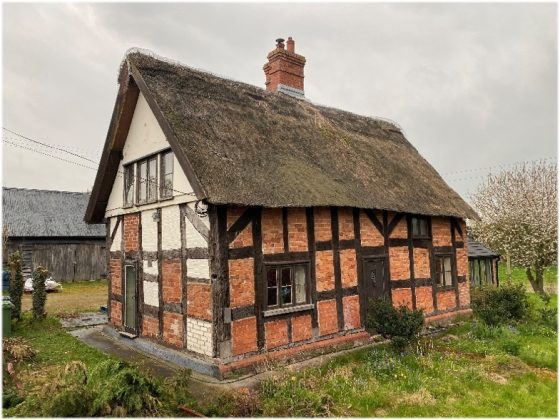
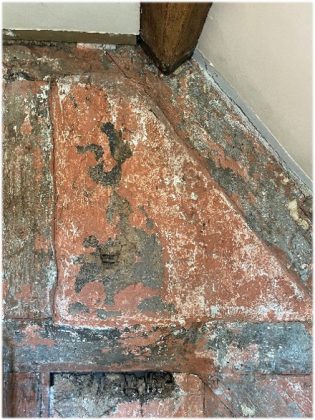
The Hollies, Shropshire. Constructed c.1650 and laterally extended shortly thereafter. Infill panels to the former gable wall frame have been drawn over the arris line of timbers with pitch applied thereover to both the infill material and framing members in a single operation, rendering the elevation seamlessly weather protected. |
|
Limewash, in particular, emerges as a critical component of historic weather protection. Archival photography and site investigations frequently reveal evidence of its application to entire elevations, with no distinction between individual components. It is often observed as having been applied in multiple layers, with the accumulated build up suggestive of recurrent activity. This is not decorative flourish, rather a functional system that helped to:
- Reduce rainwater penetration and air transmittance.
- Improve internal environmental conditions.
- Protect timbers and deter beetle activity.
Importantly, limewashing as a practice was not restricted by status or region. Its low cost and ease of application allowed it to be maintained by occupants, thus forming a continuous cycle of care. In contrast, higher status buildings employed artisans to apply coloured limewashes, with alternative finishes such as varnishes and linseed oil based paints applied to timbers, both for protective and aesthetic purposes.
The application of external plasters was commonplace from the 16th century onwards, with authors such as Sir Basil Oliver noting that this was done either at the point of construction or as a later improvement. Motivations were practical as much as stylistic, with their remedial application during the early part of the 18th century driven by:
- Georgian architectural preference.
- Occurrence of the Maunder Minimum, a period of lowered global temperature.
- The Great Fire of London, and other similar events.
Arts and Crafts Movement
In response to these key drivers, their application respectively provided a cost effective means of regularising irregular façades, improving thermal comfort for occupants and providing a means of external fire protection. In many cases, these coatings would go on to perform effectively until the 19th century reversal.
In an architectural context, the philosophical changes of the 19th century that inspired the Arts and Crafts movement, also led to the widespread stripping of protective finishes from timber framed buildings. Figures such as William Morris, inspired by John Ruskin’s advocacy for honesty of materials, promoted an architectural aesthetic that celebrated exposed timber. Whilst technically refined in new build work of the time, where framing was carefully detailed to proactively shed water, this approach proved problematic when applied to the buildings that had provided inspiration of thought. Finishes were removed, frames were exposed, and timbers were embellished with tars and oils. Water could get in but the applied treatments now restricted rates of structural evaporation, a defect that would be dramatically compounded during the 20th century following the populist use of cementitious mortars, foam fillers and resinous repairs.
The consequences of these well intentioned interventions are now well understood; however their metric of success is now only be measured in terms of the scale of decay they have perpetuated. The increased moisture loading of timbers (most notably at points of connection, horizontal surfaces and at low level), combined with the application of moisture restrictive materials, has created surface conditions primed for biological decay and wood boring beetle activity, with the nett result being the progressive degradation of timbers. Case studies repeatedly demonstrate the severity of such outcomes, with the structural impairment and failure framing members now all too common an occurrence.
 |
 |
|
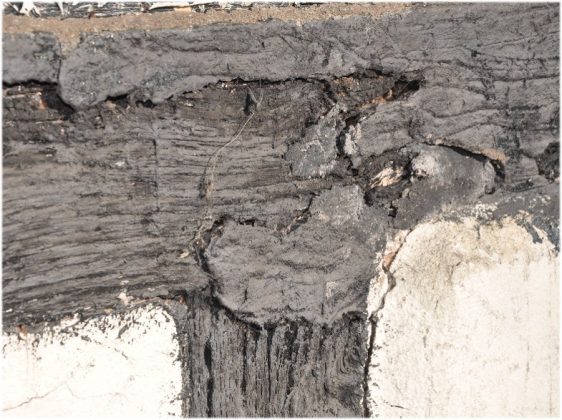
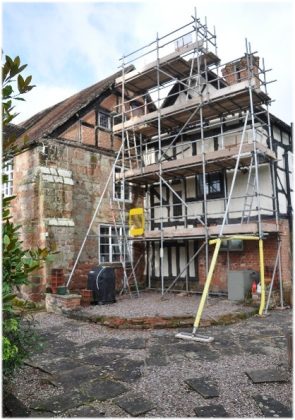
Dodford Priory, Worcestershire. Original frame constructed c.1350 but incorporates significant 17th century additions. During the 1970’ cementitious mortars, sealants and solutions of tar were applied to the timber frame in an attempt to slow its decline. Since this intervention, the frame has deteriorated at an accelerated rate, ultimately leading to the structural failure of the tie beam and corner post. |
|
Encouragingly, there is growing recognition within the conservation sector of the need to reverse these trends. For whilst the conservation of timber framed buildings requires a balance between aesthetics and technical necessity, the widespread preference for exposed framing continues to be proven problematic in terms of longer term building performance.
Moving forwards, further empirical research is needed to quantify the benefits of traditional finishes, under both current and future climatic conditions. As environmental pressures intensify, it is my professional opinion that the consequences of previous interventions will become more acute. Therefore, if timber framed buildings are to avoid the loss historic fabric within a constrained time period, a reassessment of prevailing approaches is required at a national level.
Far from reactionary, the measured path lies in first recognising that these buildings were never intended to be presented in the manner we have grown accustom, then acknowledging that their survival has always depended on the quiet effectiveness of their protective skins.
About the Author
Corey Lane is a Fellow of the Institute of Carpenters (FIOC), an Expert Member of ICOMOS’ International Wood Committee, and serves as Director and Principal Surveyor at Hawksmoor Stuart Associates Ltd. With over 15 years of dedicated experience in the heritage sector, Corey specializes in the building pathology, material analysis, and evidence-based repair of historic assets.
He holds postgraduate qualifications in Building Surveying and Historic Environment Conservation. His widely recognized research centers on the historic application of lime surface finishes to timber-framed buildings, flood resilience, and the specification of traditional lime mortars. Corey has previously served as a Senior Conservation Officer with Shropshire Council and worked within national heritage frameworks for English Heritage. He is an active member of the SPAB Casework Committee and the Worcestershire Diocesan Advisory Committee, and lectures on postgraduate conservation courses at Birmingham and Cardiff Universities.
Notable Timber & Conservation Projects:
Bishop Lloyd’s Palace, Chester (Grade I): Specialist timber investigation, in-situ material testing, and structural analysis.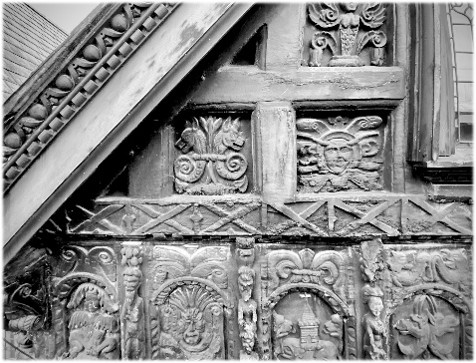
Lyveden New Bield, Northampton (Grade I): Specialist historic timber investigation, mortar sampling, and composition analysis for the National Trust.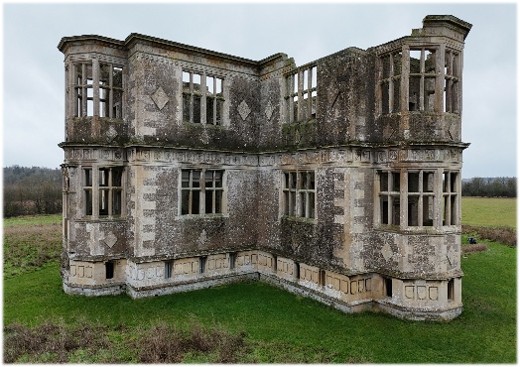
Pitchford Hall, Shropshire (Grade I): Detailed structural survey and repair specification for the historic estate culvert, including mortar analysis.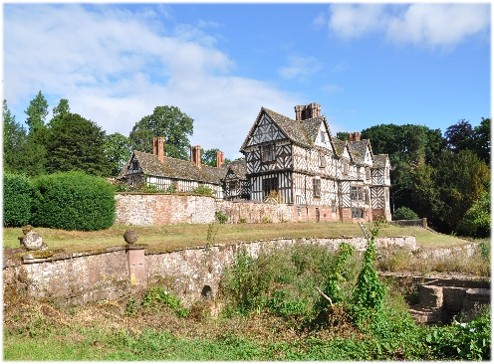
Dodford Priory, Worcestershire (Grade II*): Comprehensive structural pathology survey, repair specification, and management of remedial masonry works.
For technical inquiries or advice regarding historic timber frames and traditional materials analysis, contact Corey at corey@hawksmoorstuart.co.uk or visit www.hawksmoorstuart.co.uk.