


Our Coat of Arms Granted by the College of Arms
Formed in 1890 by eleven craftsmen, the Institute has set standards in carpentry and joinery for more than 130 years. Our arms, granted by the College of Arms, carry the tools and timber of the trade.
Born from a standard
The Institute of Carpenters was formed in 1890 by eleven craftsmen who had passed the first-class examinations of the Worshipful Company of Carpenters, one of the oldest livery companies.
From the start, the Institute existed to maintain the traditions of the ancient craft of carpentry and to advance the status of the woodworking crafts – and it has been setting standards across carpentry and joinery ever since.
In 1990 the Institute’s Council asked the College of Arms for a Coat of Arms of its own. The grant that followed records the Institute’s history and gives it arms, a crest and a badge.
A century in the making
- 1890Formed
Eleven craftsmen who passed the Worshipful Company of Carpenters’ first-class examinations form the Institute.
- 190322 January
Incorporated as the Incorporated British Institute of Certified Carpenters.
- 19765 June
Renamed the Institute of Carpenters.
- 199028 February
The Earl Marshal issues a Warrant for the grant of arms.
- 19912 April
The College of Arms grants the Institute its Coat of Arms.
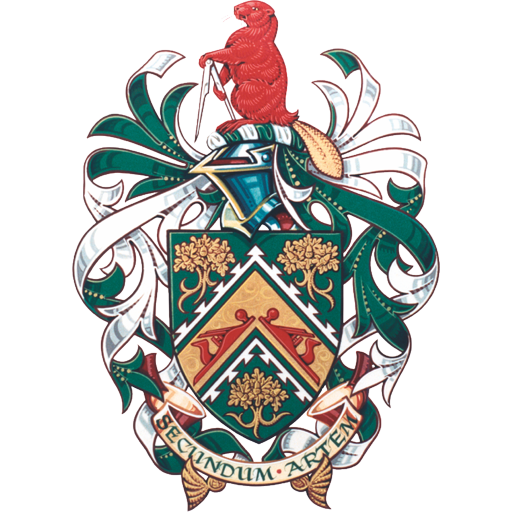

Arms, crest and badge
Each part of the grant is described in heraldic language, known as a blazon. Here is each one, with a plain-English description.
The Arms
BlazonVert on a Chevron Or between two Cottice dovetailed on the outer edge Argent two Carpenters Planes in chevron Gules all between three Oak Trees eradicated Gold.
In plain English: a green shield with a gold chevron edged by two silver dovetailed bands. On the chevron are two red carpenter’s planes, and around it stand three uprooted gold oak trees.
The Crest
In plain English: on a helm with a wreath of silver and green sits an upright red beaver with a gold tail, holding a pair of silver compasses. The mantling is green and silver.
The Device or Badge
BlazonOn a Roundel Or a Roundel dovetailed Vert thereon an Oak Tree eradicated Gold.
In plain English: a gold disc bearing a green disc with a dovetailed edge, and on it an uprooted gold oak tree. The badge also features on the Coat of Arms, and is the Institute’s emblem in its own right.
Granted by the Kings of Arms
The arms were granted on 2 April 1991 under a Warrant from the Earl Marshal, Miles Francis Stapleton, Duke of Norfolk, dated 28 February 1990. The grant was made by three Kings of Arms:
Terence Stuart Mallison, President of the Institute, on behalf of its Council.
The second day of April, in the fortieth year of the reign of Queen Elizabeth II (1991).
Earn your mark. Join today.
Become part of a standard that has lasted since 1890.